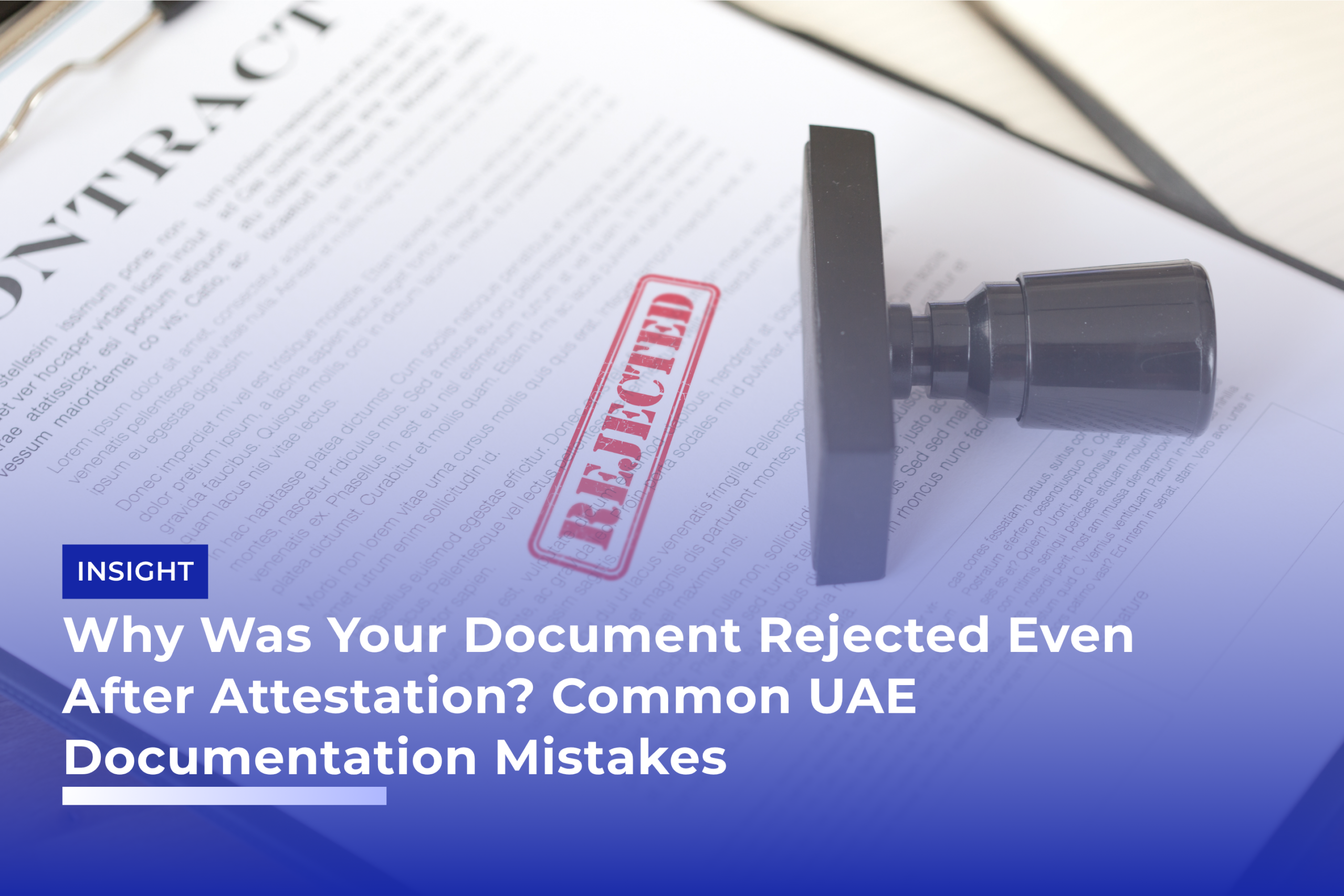
You completed the attestation process, paid the required fees, and submitted your document to the relevant UAE authority. Then came an unexpected response: the document was rejected.
For individuals and businesses, this can be frustrating. Attestation is intended to verify the authenticity of a document, so why would an authority refuse something that has already been attested?
The answer is that attestation is only one part of document compliance in the UAE. A document may be genuine and properly attested but still fail to meet the specific requirements of the government department, immigration authority, employer, bank, court, licensing body, or other organisation requesting it.
Problems with translation, document format, names, missing supporting pages, the attestation sequence, or the type of document submitted can all result in rejection.
This guide explains the most common reasons attested documents are rejected in the UAE and how to reduce the risk of delays, repeated submissions, and additional costs.
What Does Document Attestation Mean in the UAE?
Document attestation is the process of authenticating a document so that it can be recognised for official use.
Depending on the document’s country of origin and intended purpose, authentication may involve several authorities before the document is ready for use in the UAE.
Documents Commonly Requiring Attestation
These may include:
- Degree and educational certificates
- Marriage certificates
- Birth certificates
- Powers of attorney
- Commercial documents
- Company documents
- Legal agreements
- Other official certificates
However, completing attestation does not automatically mean every UAE authority must accept the document for every purpose.
Why Can an Attested Document Still Be Rejected?
Government authorities evaluate more than the attestation stamp itself.
They may also review whether:
- The correct document has been submitted
- The required attestation sequence was followed
- The information matches other supporting documents
- Translation requirements have been satisfied
- The document remains valid for its intended purpose
- All required pages and attachments are included
This is why document preparation should be based on the requirements of the receiving authority, not simply on whether a document has been attested.
Common Reasons Attested Documents Are Rejected in the UAE
The Document Was Attested in the Wrong Sequence
Attestation procedures often involve multiple stages.
For a foreign-issued document, the process can depend on the country of origin and document type. If a required authentication stage was missed or completed incorrectly, the UAE authority receiving the document may refuse it.
Before beginning, confirm the correct sequence for that specific document and purpose.
MOFA Attestation Is Missing Where Required
For many foreign-issued documents intended for official use in the UAE, authentication by the UAE’s Ministry of Foreign Affairs may form an important part of the process.
A document may have stamps from authorities in its country of origin but still require further authentication in the UAE.
Applicants should therefore check whether the receiving authority requires final UAE-level attestation before submission.
The Translation Is Not Accepted
One of the most common mistakes involves translation.
A document may be properly attested but still be rejected if the authority requires an Arabic translation and the translation does not meet its standards.
Common Translation Problems Include
- Using an unapproved translator
- Translating only part of the document
- Spelling names differently from the passport
- Incorrectly translating legal terminology
- Missing stamps, seals, or supporting text
Where certified or legal translation is required, applicants should ensure the translation is suitable for official UAE use.
Names Do Not Match Across Documents
Even small differences in names can cause problems.
For example, a passport may show:
Mohammed Ahmed Khan
while a degree certificate shows:
Mohammad A. Khan
Although both may refer to the same person, an authority may require clarification or additional documentation.
Check Name Consistency Across
- Passport
- Emirates ID
- Residence visa records
- Educational certificates
- Marriage certificates
- Birth certificates
- Commercial documents
If inconsistencies exist, determine what supporting evidence is required before submission.
The Wrong Version of the Document Was Attested
Sometimes applicants attest a document that appears correct but is not the version required for the transaction.
Examples could include submitting:
- A provisional educational certificate instead of a final degree
- An unofficial copy instead of the required original or certified copy
- An outdated company document
- A document missing required supporting pages
Before paying for attestation, confirm exactly which document the receiving authority requires.
The Document Is Incomplete
Attestation does not correct an incomplete document.
A document can contain valid authentication stamps and still be rejected because:
- Pages are missing
- Annexures are not attached
- Required signatures are absent
- Supporting certificates are missing
- Information is unclear or unreadable
Always review the complete document package before submission.
The Document Has Expired or Is Too Old for the Transaction
Not every official document can be used indefinitely.
Depending on the transaction, authorities may require recently issued documents or documents that remain within a particular validity period.
This can affect documents such as certain certificates, clearances, statements, and other supporting records.
Check the receiving authority’s validity requirements before beginning attestation.
Information Does Not Match the Application
Document details should match the information entered into the government application.
Common discrepancies include:
- Different passport numbers
- Incorrect dates of birth
- Spelling differences
- Different company names
- Incorrect licence information
- Old residential information
A small data-entry mistake can lead to additional review even when the supporting document itself is genuine.
Document Rejection Problems Businesses Commonly Face
Documentation errors can also affect corporate transactions.
Trade Licence and Company Documents
Incorrect or outdated company documents can delay licence amendments, renewals, or other government approvals.
Power of Attorney Documents
A Power of Attorney may require specific wording, authentication, translation, or notarisation depending on how it will be used.
Commercial Agreements
Foreign-issued commercial documents may require additional legalisation before being accepted for certain UAE transactions.
Employee Educational Certificates
An attested degree may still face problems if information is inconsistent with the employee’s passport or if additional verification is required for the role.
For businesses, these delays can affect hiring, licensing, banking, and day-to-day operations.
What Should You Do If Your Attested Document Is Rejected?
Receiving a rejection does not necessarily mean you must restart the entire process.
Step 1: Identify the Exact Reason for Rejection
Do not immediately resubmit the same document.
Determine whether the problem concerns:
- Attestation
- Translation
- Document type
- Missing information
- Name mismatch
- Supporting documents
Step 2: Check the Receiving Authority’s Requirements
Different authorities may have different documentation standards.
Confirm what that particular authority expects.
Step 3: Correct Only What Is Required
If the issue is a translation or missing supporting document, complete the necessary correction rather than unnecessarily repeating every stage.
Step 4: Review the Full Application Before Resubmission
Check the corrected document against all other information in the application.
How to Prevent Document Rejection Before Attestation
The best time to check a document is before paying for attestation.
Confirm the Purpose of the Document
Explain whether the document will be used for:
- Employment
- Visa processing
- Company formation
- Family sponsorship
- Court proceedings
- Banking
- Professional licensing
- Another government transaction
The intended use can affect the required process.
Verify the Correct Attestation Route
Requirements can vary based on:
- Country of issue
- Document type
- Receiving authority
- Intended purpose
Check Translation Requirements in Advance
Determine whether certified Arabic translation or another specific translation format is required.
Review Every Personal Detail
Names, dates, passport details, and company information should be checked carefully.
Keep Complete Copies
Maintain digital copies of the original document, attestations, translations, and supporting records.
How Professional Attestation and PRO Services Can Help
Document attestation can become complicated because several authorities and requirements may be involved.
Professional support can help manage the process from beginning to end.
Pre-Attestation Document Review
Checking whether the correct document is being submitted before the authentication process begins.
Attestation Coordination
Helping manage the required authentication stages for UAE use.
Certified Translation Support
Arranging appropriate translation where required for government submissions.
Government Documentation Assistance
Reviewing supporting documents before applications are submitted.
Rejected Document Support
Identifying potential problems and assisting with the necessary corrections before resubmission.
For businesses processing large numbers of employee or corporate documents, professional document management can also reduce the workload placed on internal HR and administrative teams.
Frequently Asked Questions About UAE Document Rejection
Why was my document rejected even though it was attested?
Attestation verifies authenticity, but the receiving authority may also require specific document formats, translations, supporting records, matching information, or additional authentication.
Can an incorrect translation cause an attested document to be rejected?
Yes. If certified or legal translation is required, an unacceptable or inaccurate translation can cause problems even when the original document is properly attested.
Do all foreign documents need MOFA attestation in the UAE?
Requirements depend on the document, its origin, and its intended use. Applicants should verify the exact requirements with the relevant authority before submission.
Can a spelling difference in my name cause document rejection?
Yes. Differences between passports, certificates, Emirates ID records, or other documents can lead to additional verification or rejection.
Do I need to attest the document again if it is rejected?
Not necessarily. It depends on the reason for rejection. A translation, missing attachment, data mismatch, or other issue may be correctable without repeating the entire attestation process.
Can PRO services help with rejected documents?
Yes. Professional PRO and attestation providers can review the rejection reason, check documentation, arrange required translation or authentication, and assist with resubmission.
Conclusion: Get the Document Checked Before You Get It Attested
An attestation stamp confirms authenticity, but it does not guarantee that a document satisfies every requirement of the UAE authority receiving it.
Many document rejections are caused by preventable issues: incorrect attestation sequences, missing authentication, unacceptable translations, name mismatches, outdated documents, incomplete pages, or simply submitting the wrong document for the transaction.
The safest approach is to work backwards from the final requirement. First determine exactly what the receiving authority needs, then complete the appropriate translation, authentication, and attestation process.
For individuals, this can prevent delays in visas, employment, family sponsorship, and other important transactions. For businesses, proper document management can protect hiring timelines, licensing procedures, and government approvals.
With careful preparation and experienced attestation and PRO support, you can significantly reduce the risk of hearing the frustrating words: “Your document has been rejected.”